ensure safety
E-MOBILITY & HIGH VOLTAGE
We support you along the entire value chain of electronics manufacturing. Our experts not only preventively evaluate the risk of failure of assemblies and functional units. They also analyze failures in validation tests and damage in the field concerning the mechanism and underlying causes. Based on this, specific solutions are developed.

Prevent risks before they occur.
Do you have challenges with failing assemblies in the field? Is your assembly is still in the design phase, and you want to identify potential risks?

RISK ASSESSMENT OF PARTICLES ON ELECTRONIC ASSEMBLIES
Risk assessment Technical Cleanliness:
We analyze the safety of your assemblies against short circuits and impairment of the insulation coordination triggered by conductive particles.
You select the corresponding degree of contamination based on the short-circuit risk determined.

RISK ASSESSMENT LEAKAGE CURRENT AND CONDENSATION
Risk assessment leakage:
The hygroscopy and, thus, the increase in the risk of condensation due to ionic contamination is estimated for you by ion chromatography*
The last results will assist you in making decisions on the degree of contamination, cleanliness, and coating.
CONFORMAL COATING:VALIDATION & ROUTINE TESTING
Coating Validation:
Utilizing the CoRe test & iodine vapor test, we analyze if the coating successfully neutralizes the particle and if the protective effect of the coating is given accordingly.
We develop recommendations for you for the improvement of your coating process.
Maximum humidity robustness for components
Understanding risks. Avoiding defects.
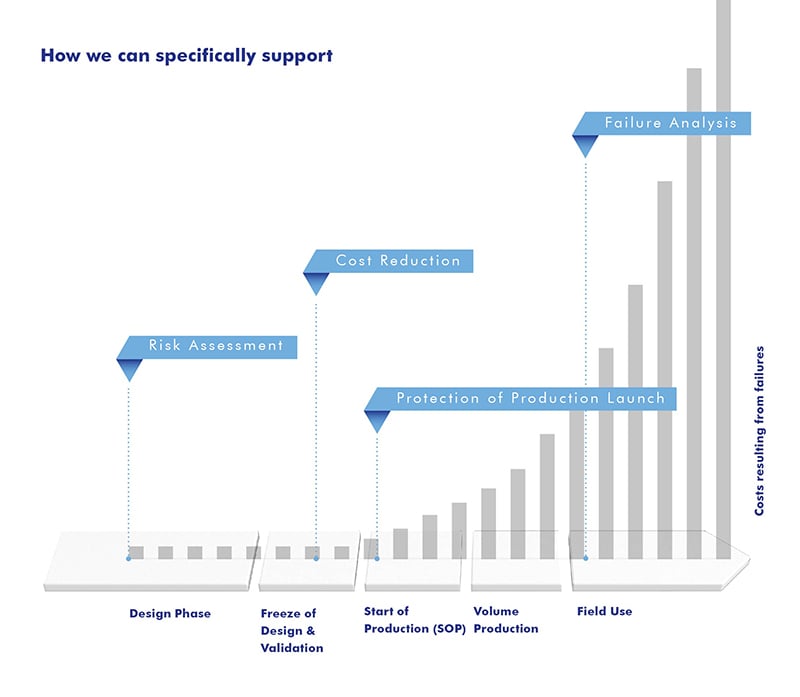
✓ Risk Assessment
Additional methods for identifying weak points
✓ Cost Reduction
Evaluation of reliability tests with regard to potential savings in processes and purchased parts
✓ Protection of Production Launch
Proof of compliance with the specifications at the start of serial production
✓ Failure Analysis
Development of sustainable, cost-optimized remedial measures
➞ The earlier weak points are identified and eliminated in the assembly's production process and processes optimized, the lower the costs.
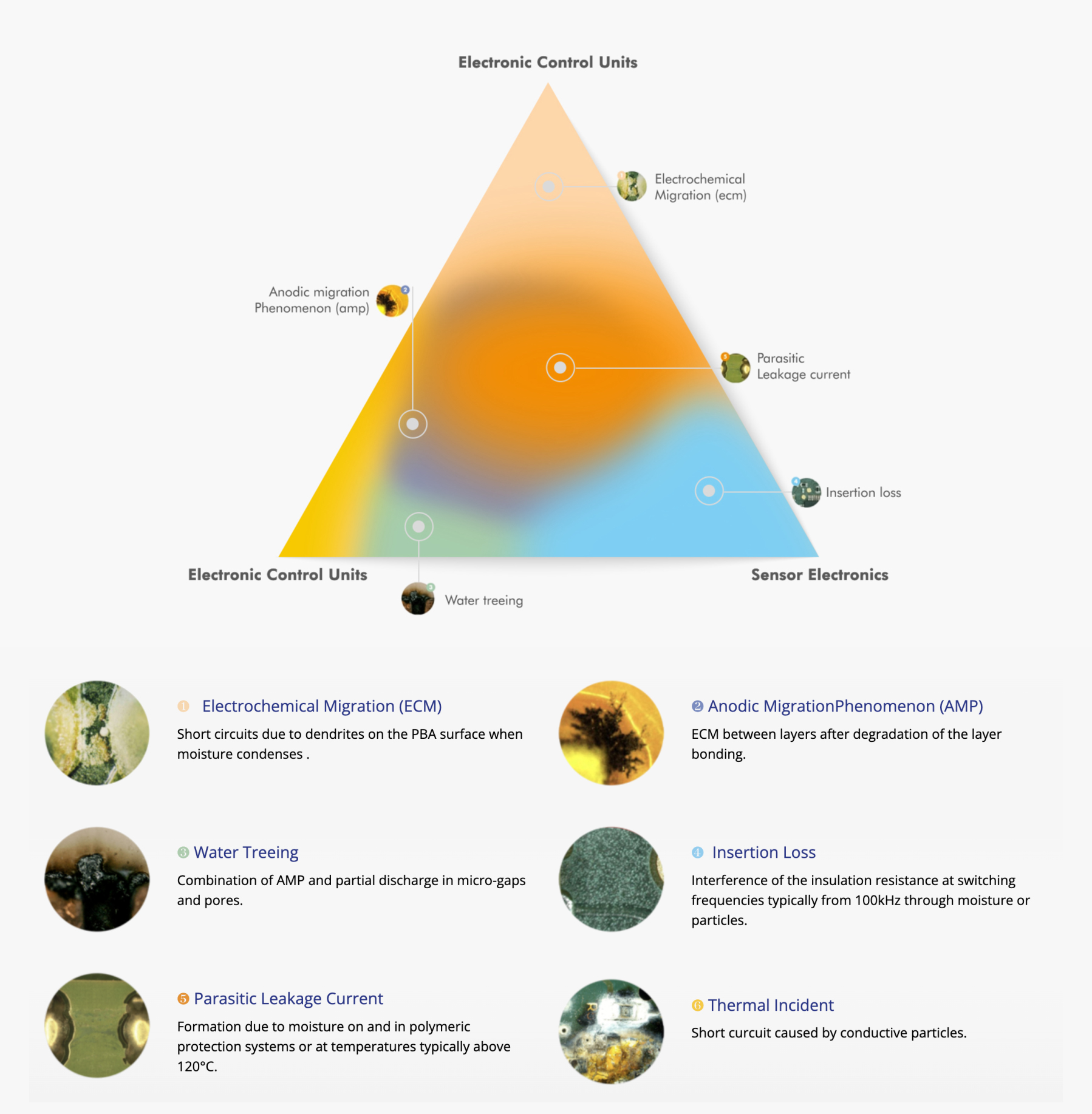
Typical causes of failure for assemblies and functional units
We know the typical causes of failure for assemblies and functional units are caused by moisture, contamination, and particles, but their explicit identification is the key to remedial measures. Our experienced analytics team has processed over 1000 cases and has the highest quality analytical equipment. This way, we quickly and flexibly conduct a detailed risk, failure, and root cause analysis and develop corrective measures.
You can rely on our competence and experience to solve your challenges.
We advise. You benefit.
✓ Specific, economically feasible recommendations for action in the system context.
✓ Confidential and systematic approach – NDA available
✓ Close exchange with our experienced team
✓ Analytics or system discussion – as required
FAQs for E-Mobility & High Voltage Electronics
Answer: Technical cleanliness refers to the absence of particles and ionic contamination on electronic assemblies. In high-voltage and e-mobility systems, contaminants can compromise insulation coordination and increase the risk of short circuits, leakage currents, or failure under HV stress. Proper cleaning and particle assessment improve reliability and meet safety requirements.
Answer: Particulate contamination, moisture, and ionic residues can reduce insulation performance and trigger electrical breakdowns, corrosion, and leakage currents — especially at voltages typical in e-vehicles and power electronics (400-1200 V+). Managing contamination helps prevent field failures and improves long-term reliability.
Answer: Typical causes of failure include moisture uptake, contamination-induced leakage current, particulate-triggered short circuits, and electrochemical migration. Each can degrade insulation and lead to catastrophic breakdown if not properly controlled through cleaning, risk assessment, and protective measures.
Answer: Zestron provides analytics, risk assessments, particle and ionic contamination analysis, and coating validation to help identify weak points early. These services guide corrective measures and optimize processes to reduce field failures and support successful production launches.
Answer: Techniques include ion chromatography for ionic contamination, particle risk assessment, and coating validation tests (e.g., CoRe test & iodine vapor) to ensure insulation and protective coatings perform under expected conditions.
Answer: Yes. High-voltage systems have stricter requirements for insulation coordination and contamination control. Cleaning and evaluation must address particle conductivity and moisture susceptibility, beyond basic residue removal used in low-voltage electronics.
Answer: Conformal coatings protect assemblies from environmental stress, but their effectiveness depends on prior cleanliness. Particulates or residues beneath the coating can undermine insulation and lead to failure, so validating coating performance is critical.
Answer: Early evaluation during design and pre-production helps identify potential failure mechanisms, select appropriate cleaning measures, and optimize coating and assembly processes—reducing cost, shortening launch timelines, and improving overall reliability.